Physics · Generative Modeling · Physics Inspired AI System

Chen Mu

Physics undergraduate at Sun Yat-sen University interested in generative modeling and the training and development of AI systems inspired by physics and real-world data.

Institution
Sun Yat-sen University
Program
Physics undergraduate
Location
Shenzhen, China
Period
Sept. 2024–Present
Expected June 2028

Generative Modeling Real-World- and Physics-Inspired AI Systems

My current interests include diffusion and flow matching, controllable generation, sampling dynamics, ODE/SDE probability transport, scientific machine learning, and physics- and real-data-inspired AI training and system building. I am particularly enthusiastic about algorithms and operator-based methods, while continuing to build deeper theoretical and practical foundations in these areas.

Independent coursework project · 2026

Diffusion, Flow Matching, and CRH-CFG

I independently completed the publicly available coursework and assignments from CMU 10-799, Diffusion and Flow Matching.

Implemented
DDPM, straight-path Flow Matching, DDIM, Euler and Heun samplers, and conditional classifier-free guidance.
Experiment setting
CelebA 64×64; Modal L40S; independent ResNet-18 evaluator.
Abstract
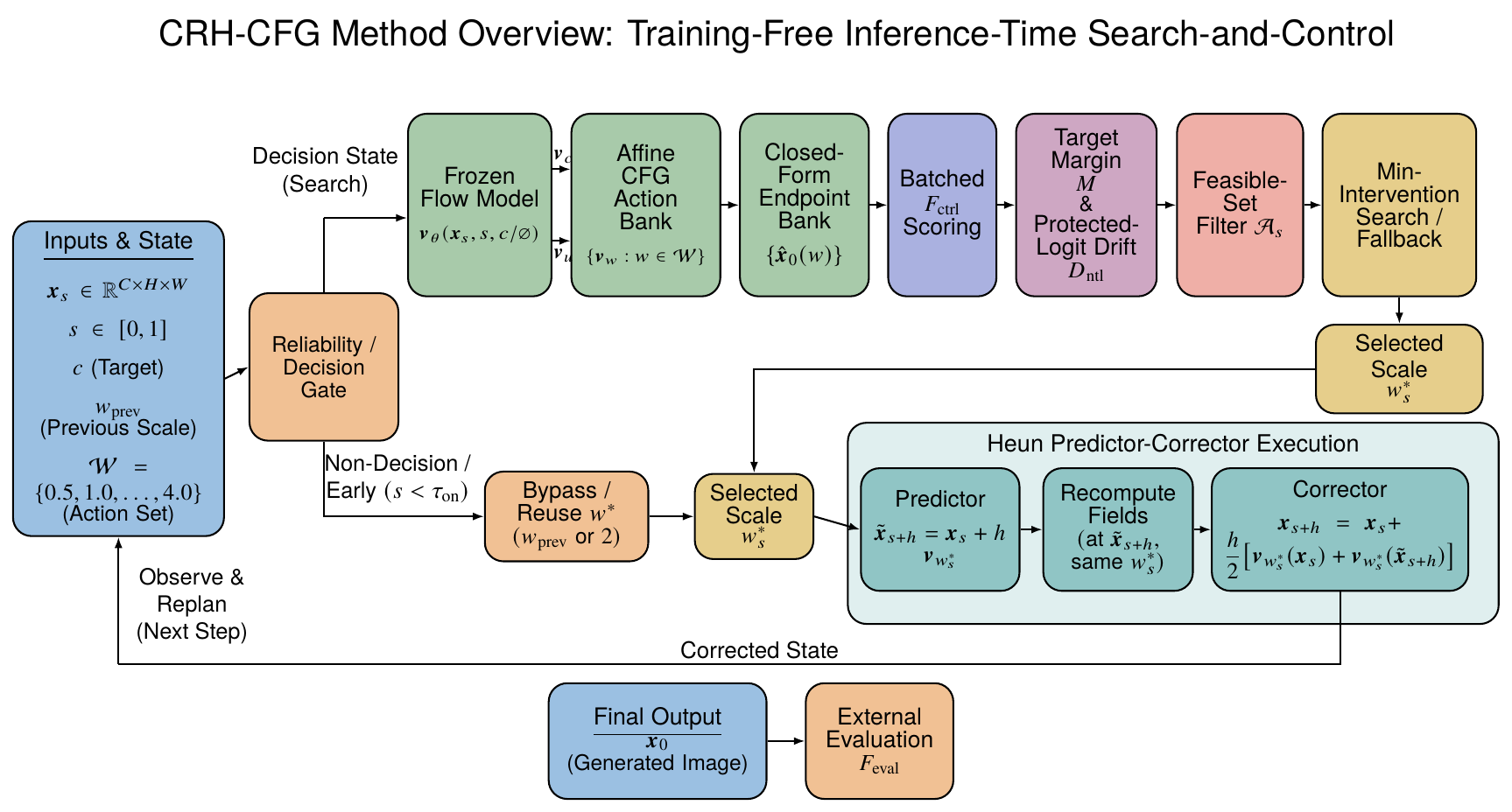
Classifier-free guidance (CFG) usually uses a fixed scale and cannot respond to sample-specific generation states. We ask whether a frozen conditional-unconditional field pair can instead support online adaptation without additional generator evaluations. We introduce Constraint-aware Receding-Horizon Classifier-Free Guidance (CRH-CFG), a constrained receding-horizon search over scalar CFG actions. The search proceeds in three stages. First, it affinely reuses the field pair to construct candidate velocities and closed-form clean-endpoint estimates. Second, a frozen evaluator scores these endpoints; target-margin and protected-logit-drift constraints define the feasible set, within which the algorithm selects the action closest to ordinary conditioning and the previous choice, with a fallback when none is feasible. Third, it executes the selected action for one Heun macro-step, recomputes fields at the predicted state, and searches again after correction. This training-free search adds evaluator work but no additional generator evaluations and retains the original Heun discretization. CelebA experiments show modest adherence improvement at low overhead, while preservation and conditional quality gains remain unsupported.

Engineering disclosure: Codex assisted engineering; I retained research design, interpretation, and validation.

Physics and research engineering projects

Darcy-coupled tumor drug transport

A Mathematica finite-element framework coupling Darcy flow with convection–diffusion–reaction transport for intratumoral drug simulation.

Read project paper (PDF)

Bird-vocalization acoustic features

An automated acoustic feature-extraction workflow developed around bird-vocalization data from the Shenzhen–Hong Kong border.

Read project paper (PDF)

Mathematica-based agent harness

Research engineering for AI-assisted scientific workflows, connecting symbolic computation, experiment execution, and auditable outputs.

Private repository

Education and skills

Education

Major in Physics
Sun Yat-sen University
Sept. 2024–Present
Expected June 2028 · Shenzhen

Technical skills

  • Python, C++, C, Wolfram Language
  • PyTorch and scientific ML
  • Server administration and Unix-like systems
  • Docker, LaTeX, and BibTeX
  • TOEFL iBT 104; CET-6 596

Selected recognition

First Prize, 2nd “Illuminating the Future” Optics Science Communication Writing Competition

UCAS Education Foundation / Wiley · “Chirped Pulse Amplification: Born from Playing with Fire”

USACO Gold

Spring 2026

Research assistant opportunities

I am seeking research assistant opportunities in computer science and AI, especially projects where a physics background can inform modeling, dynamics, control, or scientific reasoning.

chenm369@mail2.sysu.edu.cn · GitHub · CV (PDF)